
Real Numbers Class 10 Maths NCERT Solutions – Hindi & English
Complete guide for Real Numbers Class 10 Maths NCERT Solutions including examples, exercises, MCQs, important questions, and PDF download.
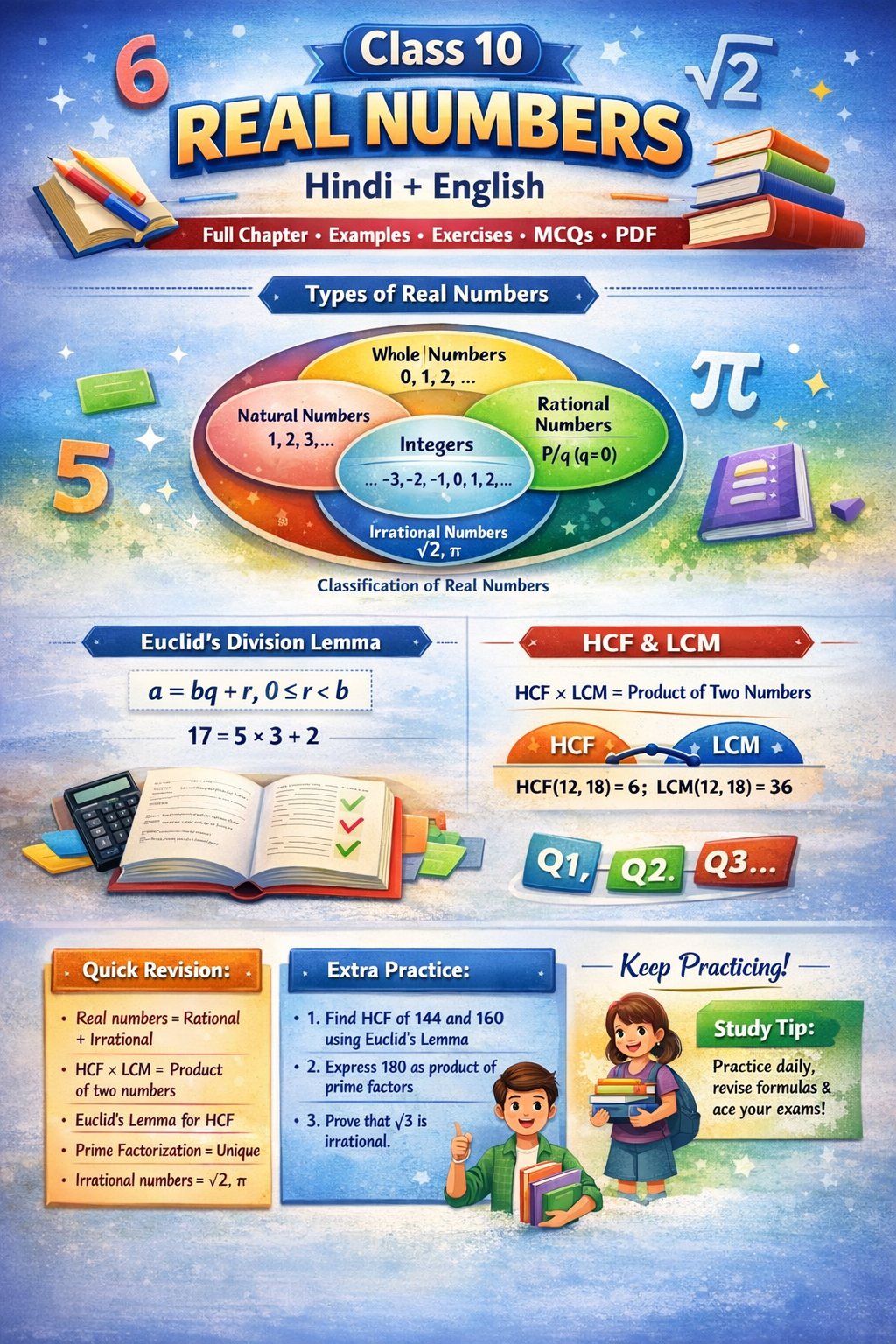
Introduction – Real Numbers Class 10 Maths NCERT Solutions (परिचय)
English: Numbers that can be represented on the number line are called real numbers. Hindi: संख्या रेखा पर दर्शाई जा सकने वाली सभी संख्याएँ वास्तविक संख्याएँ कहलाती हैं। Example: 2, –3, 5/4, √7 English: Counting numbers starting from 1 are called natural numbers. Hindi: 1 से शुरू होने वाली गिनती की संख्याएँ प्राकृतिक संख्याएँ कहलाती हैं। Example: 1, 2, 3, 10 English: Natural numbers along with zero are called whole numbers. Hindi: प्राकृतिक संख्याओं में 0 को जोड़ने पर पूर्ण संख्याएँ बनती हैं। Example: 0, 4, 9 English: Numbers including positive, negative numbers and zero are called integers. Hindi: धनात्मक, ऋणात्मक और शून्य को मिलाकर पूर्णांक कहलाते हैं। Example: –5, –1, 0, 6 English: Numbers that can be written in the form p/q, where q ≠ 0. Hindi: जो संख्या p/q के रूप में लिखी जा सके (q ≠ 0), वह परिमेय संख्या है। Example: 3/5, –7/2, 0.25 English: Numbers that cannot be written in the form p/q. Hindi: जो संख्या p/q के रूप में न लिखी जा सके, अपरिमेय संख्या कहलाती है। Example: √2, √5, πTypes of Real Numbers – Real Numbers Class 10 Maths NCERT Solutions
Natural Numbers – Real Numbers Class 10 Maths NCERT Solutions (प्राकृतिक संख्याएँ)
Whole Numbers – Real Numbers Class 10 Maths NCERT Solutions (पूर्ण संख्याएँ)
Integers – Real Numbers Class 10 Maths NCERT Solutions (पूर्णांक)
3. Euclid’s Division Lemma (यूक्लिड विभाजन प्रमेय)
English: For two positive integers a and b, a = bq + r, where 0 ≤ r < b.
Hindi: किसी भी दो धनात्मक पूर्णांकों a और b के लिए a = bq + r, जहाँ 0 ≤ r < b।
4. Fundamental Theorem of Arithmetic (यूक्लिड विभाजन विधि)
English: A step-by-step method to find HCF using Euclid’s Lemma.
Hindi: HCF निकालने की चरणबद्ध विधि।
5. HCF / GCD (महत्तम समापवर्तक)
English: The greatest number that divides two or more numbers exactly.
Hindi: वह सबसे बड़ी संख्या जो दी गई संख्याओं को पूर्णतः विभाजित करे।
6. LCM (लघुत्तम समापवर्त्य)
English: The smallest number that is exactly divisible by given numbers.Hindi: वह सबसे छोटी संख्या जो दी गई संख्याओं से पूर्णतः विभाज्य हो।
7. NCERT Exercises 1.1 – 1.4
Exercise 1.1 (अभ्यास 1.1)
Solution:
225 = 135 × 1 + 90
135 = 90 × 1 + 45
90 = 45 × 2 + 0
∴ HCF = 45
382 = 196 × 1 + 186
196 = 186 × 1 + 10
186 = 10 × 18 + 6
10 = 6 × 1 + 4
6 = 4 × 1 + 2
4 = 2 × 2 + 0
HCF = 2
Exercise 1.2 (अभ्यास 1.2)
140 = 2 × 70
70 = 2 × 35
35 = 5 × 7
∴ 140 = 2² × 5 × 7
306 = 2 × 3² × 17
657 = 3² × 73
HCF = 9
LCM = 2 × 3² × 17 × 73
Exercise 1.3 (अभ्यास 1.3)
7 × 11 × 13 + 13
= 13(7 × 11 + 1)
= 13 × 78
∴ It is a composite number.
Assume √5 is rational.
√5 = a/b (a, b are co-prime)
⇒ 5b² = a²
Contradiction arises.
∴ √5 is irrational.
Exercise 1.4 (अभ्यास 1.4)
13 ÷ 125 = 0.104
∴ It is a terminating decimal.
17 ÷ 8 = 2.125
∴ Terminating decimal.
8. MCQs + Assertion-Reason
a) 3/5
b) 0.25
c) √2 ✅
d) 7
a) 2
b) 4 ✅
c) 8
d) 14
a) Non-terminating non-repeating
b) Terminating or repeating ✅
c) Only terminating
d) Only non-terminating
Assertion – Reason Questions
Reason (R): Decimal expansion of √7 is non-terminating and non-repeating.
Answer: Both A and R are true and R is the correct explanation.
Reason (R): Prime factorisation is unique.
Answer: Both A and R are true.
9. Important Questions
1 Mark Questions
- Define real numbers.
- Give one example of irrational number.
2 Marks Questions
- Find HCF of 12 and 15.
- State Euclid’s Division Lemma.
3 Marks Questions
- Find LCM of 24 and 36 using prime factorisation.
- Explain why √3 is irrational.
5 Marks Questions
- Use Euclid’s Division Lemma to find HCF of 306 and 657.
- Prove that √5 is irrational.
10. Frequently Asked Questions
Frequently Asked Questions (FAQs)
All rational and irrational numbers together form real numbers.
It states that a = bq + r where 0 ≤ r < b.
Rational numbers can be written in p/q form, irrational numbers cannot.
It helps in finding HCF, LCM and solving many problems.
- Real numbers = Rational + Irrational
- HCF × LCM = Product of two numbers
- Euclid's Lemma helps in finding HCF
- Prime Factorisation = Unique
- Irrational numbers = Non-terminating & non-repeating
1. Find HCF of 144 and 160 using Euclid’s Lemma.
2. Express 180 as product of prime factors.
3. Prove that √3 is irrational.
Post your doubts and answers below.
• NCERT Official Class 10 Maths Textbook
• CBSE Academic Website
• Khan Academy – Real Numbers
• BYJU’S – Real Numbers Guide